Monday, 11 January 2016

Veto Switch Gears - Strong potential Multibagger

Monday, 11 January 2016 0 comments
Image result for veto switchgears and cables ltd
The electronics market of India is one of the largest in the world and is anticipated to grow at a compound annual growth rate  of 24.4 per cent during 2012-2020. Separately, forecasts say that the electric wire and cable market in India is to grow at a CAGR of 16.18percent over the period 2015-19. The Indian wire and cable industry is growing satisfactorily and getting more and more consolidated and becoming largely organized now. Construction cables and wire sector anticipated to see steep growth in demands in coming days owing to huge govt's, spending in infrastructure, smart cities, real estate boom, and housing explosion.

Also, the year 2015 started off on a good note for the LED industry in India. PM's initiative to launch Notional programme for LED based Home & street lightning as well as a scheme for LED

 Veto will be a big beneficiary of GST because all dubious suppliers of electrical goods in the grey market will perforce have to comply with the law, giving Veto a competitive edge.


Veto is India's first company to produce ISI mark electrical accessories in INDIA. It is engaged in the manufacturing of electrical accessories, and wires and cables in India and internationally.
Related image

Image result for veto switchgears and cables ltdThe company uses high quality raw material to give best products to its customers. The company is engaged in manufacturing wires & cables and electrical accessories (switchgear), which jointly contribute ~ 79%, to its total topline. Veto earns the remaining 21% of its revenue from trade in other business including fans, LED and CFL.

Image result for electrical accessories factoryVeto is a dominant player in Rajasthan, which contributes ~75% to its total sales. The company has a dealer network of 2314 across India with 80% based in Rajasthan. However, the company plans to expand its dealer network across India and increase the count to 5000 dealer in the next two years. Veto also plans to export its products to Middle East countries from FY17-18 through its wholly-owned subsidiary Veto Electrical Pvt Ltd. Consolidated revenues grew at 16% CAGR

Veto group has sustained the position as a leading supplier of electrical goods in the gulf countries for a time period of more than a
decade.
Products

Electrical Accessories

Image result for veto electrical accessories
 Wires and Cables
Image result for veto switchgears and cables factory

 CFL and T5 Fitting
Image result for CFL and T5 Fitting veto

 Fans
Image result for CFL and T5 Fitting veto


Led Light

Image result for led light veto

Sunday, 22 November 2015

New trading Blog

Sunday, 22 November 2015 0 comments

Monday, 20 July 2015

Phoenix Lamps: Rising from the dead! Good potential Multibagger

Monday, 20 July 2015 5 comments


Having learnt from both Warren Buffet and Phil Fisher, I have added to my own one of a kind style of stock examination that includes around 40% of investigation on the ground.  I would like to call this the Holmesian way of analysing stocks - unlike conventional analysis that relies heavily on secondary research, this creates a double loop mechanism that feeds into the other engine and helps validate or reject the thesis. This has often proven to be quite an advantage in micro caps where often “what you see is not what you get in the numbers” and vice versa.


Phoenix Lamps Ltd. ( Previously known as Halonix Ltd.) is a manufacturer of automotive halogen bulbs in India with an approximate market share of 50% in Passenger Vehicles, 70% in commercial vehicles and 70% in two Wheeler OEMs . The company is the largest manufacturer in India and also claims to be among top five globally. A near monopoly business in automotive head lamps/tail lamps gone terribly awry through a diversification into CFL’s which is cut throat, high intensity, B2C, branding heavy business. A decade later and the mistake corrected through a slump sale of the loss making CFL business Though there has been slowdown in automotive industry, but the overall long-term outlook remains positive. Phoenix Lamps Ltd., being market leader in this business is expected to grow along with the industry.

A look at the ratios and you will be impressed. High RoE, high ROCE, FCF positive business with high asset turns (11 x FA turns) with a 20 % + EBITDA margin with ROCE of 30 % +. It’s got near FMCG characteristics given the standard nature (A friend at bosch says the key to a higher margin business in auto is a. high standardization b. high value to weight/volume c. OEM + after market possibilities and that’s why bosch is always in things like ABS, wipers, air bags which are critical parts and fairly standard. The only exception are high finesse items which involve a lot of high
end labour like machining and critical engine parts.


Recently Suprajit engineering has acquired 51% of Phoenix Lamps (PL) from a PE investor at agreed price of Rs 89/share with an option to increase the stake to 62% later and this got me delving deeper again.  Let’s get the easy one out of the way –actis has been stuck in the company for 9 years and started selling down their shares (from 70 % to 60 % ) and this has resulted in the share price going down from Rs. 180 to Rs. 100 over six months with no change in fundamentals. That’s gone and a simple reversion to mean should take this atleast 50 % up.


Suprajit is well known to value investors in the indian market. I have personally interacted with ajit rai and I think he is an outsider CEO – buys cheap and is an exceptional operator with a focus on bottom line and cash flows. He has been looking at acquisitions for long and finally bought one which in his own words was a company that manufactures : Scalable, global standardized product, With a market leadership position in india market, With export possibilities, Complementary to his core business of two wheeler cables, High margins and strong cash flows with minimal debt. Given what he has done with suprajit – have a look at ROIC of 30 % consistently and his own salary/remuneration etc. and I am sure that he will do a good job of at least maintaining status quo – which by itself should lead to a re-rating.

Concluding:

Phoenix Lamps Ltd is a manufacturer of automotive halogen bulbs in India with a dominant market share. The “General Lighting” business of the company had been a drag on its financial performance for several years but that business has been sold on a slump sale. From now on the company is expected to post consistent profits on its Automotive Lamps business. Due to buoyant market conditions and Special dividend, the stock is trading at very fair valuations for the expected earnings.  Suprajit management is generally reputed to be fair & honest. They have indicated that they will at some point in the future merge the two companies and there will always be a question mark on the merger ratio until the event happens Currently the stock offers little valuation discount. I see little downside here given the open offer at Rs. 100/share and a 2-3 x upside.


Sunday, 7 June 2015

Re Post: Anuh Pharma

Sunday, 7 June 2015 0 comments
Draft 1
 The company is one of the largest manufacturers of macrolides, a kind of antibiotic drugs in the country.Among the macrolides,the company manufactures antibacterial erythromycin base and several other variants (primarily recommended)for throat infections by ENT specialists and General Physicians); it is the largest producer of erythromycin salts in the country. The company also makes higher macrolides including azithromycin, roxithromycin and clarithromycin;quinolones like ofloxacin; chloramphenicols and over a dozen corticosteroids. The company also offers an Anti TB Drug called as Pyrazinamide. All these products are being manufactured at the company’s Tarapur facility near Mumbai. The company also owns a state-of-art integrated laboratory to carry out research and development activities; this facility was acquired from a Spanish company in April, 2012. The R&D facility includes a chemical synthesis lab, an analytical development lab and a kilo lab with the view to cater to Contract Manufacturing. The R&D facility will help the company in intensifying their research & development activities with a view to enlarge the bulk drugs portfolio. All these things have helped Anuh Pharma to carve out its own niche in the world of APIs. The company is looking at different opportunities in untapped markets and also across a value chain. Today, the company is known for its Government recognized ‘Star Export House’ status; governed by cGMP, the company enjoys World Health Organization’s (WHO) version of GMP (Good Manufacturing Practice). In addition, the company has also filed several Drug Master Files (DMFs) submitted to European Directorate for the Quality of Medicines & HealthCare (EDQM) & US Food & Drug Administration (US FDA) which could create immense opportunities for erythromycin’s exports to US and Europe, going forward. The company has been exporting one-third of total production to over 57 countries and the company recently received approval from COFEPRIS (Health Authority of Mexico) GMP certificate for three of company's erythromycin products.

update:

Anuh Pharma is around Rs 330 this morning !….yet down from ex bonus High of Rs 414.75 on August 12,2015…It was a liberal 2:1 Bonus with xb date being August 5,2015.Cum Bonus the Share Price was at times over Rs 1000. 52 Week xb High of Rs 414.75 implies a cb Price of Rs 1244 while today’s xb price of Rs 340 implies a cb price of Rs 1020 .It was at just Rs 130 twenty months ago in January 2014.Gains are @ 700 % since then in 2014-15 till date
The Face Value is Rs 5 and the Equity has jumped from Rs 4.18 crs to Rs 12.54 crs with the Bonus
FY 15 PAT was @ Rs 22 crs with EPS over Rs 26.Reserves at March 31,2015 were Rs 96.7 crs giving a networth of @ Rs 101 crs and a Book of @ Rs 121
Post the Bonus the Book had moved to just over Rs 43 (Rs 40 at March 31,2015) after considering the Rs 8 crs profit in Q 1 FY 16
Assuming a FY PAT of Rs 25 crs and Rs 30 crs the FY 16 EPS would be @ Rs 10 and Rs 12 respectively
Fy 15 the Dividend was a healthy Rs 7 or 140 % (Interim of Rs 2 ~40% & Final of Rs 5 ~100%)…this was @ 26.5% payout from FY 15 Profits.Assuming similar payout for this year the Dividend should be @ 50% to 55 % on enhanced capital and would entail payout towards @ Rs 7 crs
Adjusted for FY 16 Projected Dividend the Networth should be @ Rs 120 to Rs 125 crs giving a Book of @ Rs 48 to Rs 50 at March 31,2016
Using FY 16 Projected EPS & Book at the current share price of Rs 340 this would give a PE Range of 28 to 34 and a PBV of @ 7
Even if Zero Debt such Valuations are High and need to be supported by high CAGR or non linear growth in the offing over the coming years or a Takeover Situation.Last 5 Years CAGR on Topline is 10% and on Bottomline is 12%….. exciting to run up such Relative Valuations?.So if it’s not based on the Past is there any Game Changing or Life Changing Future or Takeover that’s exciting ?
Though the Company has acquired 7800 sqm adjoining existing 3600 sqm Tarapur,Boisar Factory Land for expansion it also states that they have enough capacity to produce more on demand and increase market share without further capex spend…they have a rated capacity of 900 mtpa for macrolides etc though maximum achievable capacity is 1140 mtpa and 12 mtpa for Corticosteroids…they are currently operating at 65% of the achievable capacity …that should be @ 750mtpa
FY 15 Annual Report does not show any significant addition to Fixed Assets on account of the 7800 sq m land purchased .This must reflect in FY 16 accounts
FY 16 Topline is expected to be Rs 325 crs with continuing double digit ROE and ROCE with over 40% coming from Exports.
Thus it would seem a depreciating Rupee can be a favourable situation until one observes that in FY 15 the FX Spend on CIF Imports,Commission & Travelling were to the tune of Rs 185 crs while Export FOB Revenues were @ Rs 120 crs….so there’s a net outgo….Moreover USA was not where Exports went although they have submitted the DMF to USFDA for two Erythromycin products . 41% of FY 15 Sales came from Exports of which @ 75 % were from Europe and Latin America with the rest coming from Africa and Asia.
Thus FX Operations are in excess of Rs 300 crs in the Company and this would require Currency & Treasury management expertise to manage.FY 15 Annual Report reveals an FX Loss of Rs 2.78 crs,Raw Material Imports of Rs 193 crs,Brokerage & Commission Expenses of Rs 2.98 crs
Anuh Pharma is the largest producer of Erythromycin Salts in India and in the Top 5 in the World for both Erythromycin and anti TB Drugs (Pyrazinamide).Competition is from South East Asia and China.It commands an 18% & 20% Global Market Share for Erythromycin Salts & Pyrazinamide respectively
Anuh Pharma is part of the SK Group of the Mumbai based Shah Family and for FY 15 it presented it’s 55th Annual Report….It however completed 25 years of production on February 14,2014 when it declared a special interim dividend of Rs 1.25 for this
Interestingly the Authorised Capital is now increased in great quantum from Rs 10 crs to Rs 51 crore to facilitate the liberal Bonus and more pointedly to facilitate issue of fresh equity in requirement for funds
They also now have an enabling resolution to borrow upto Rs 200 crs.
This clearly is for the Expansion on the new adjoining land of 7800 sq m,that’s over twice existing Tarapur land of 3600 sqm, that would serve Regulated markets with a State of the Art Facility planned to be commissioned by FY 17
What is really interesting is that the New Authorised Capital has room for fresh issue of 7.7 cr shares !…at current market price of Rs 340 that would mean raising over Rs 2500 crs through Equity ! while Borrowing Powers are restricted to just Rs 200 crs !…..If the Funds are raised to this maximum the Networth flies past Rs 2600 crs from just Rs 120 crs ! and the Capital Employed jumps from Rs 120 crs to over Rs 2800 crs with Full Borrowings of Rs 200 crs
What a Giant Leap this would be assuming such Quantum of Funds are required for Projects !….Project & Expansion Capex & Cost Details are not available
Such a Leap would take Promoter Holding down to just 17.5% assuming they do not participate in the fresh equity exercise.Such a drastic dilution would make the Promoters vulnerable and is therefore unlikely
They currently hold 71% already in an exiting Equity of Rs 12.54 crs.They can hold a maximum of 75% which if the Equity does move to the maximum 10.2 cr shares and Rs 51 crs they can hold a maximum of 7.65 cr shares from the current 1.79 crs they hold.That would require them to infuse Rs 2000 crs themselves.Nah!.What probably will happen is that Promoters will dilute their Equity Stake to quite some extent in the Fresh Infusion of Equity Funds,most probably through a Preferential Allotment or QIP Placement.Currently there is no institutional holding
Clearly the Shah Family which holds over 71% (up from 65% earlier this year) or 1.79 crs of the Equity is very ambitious and realise that after 55 years they have just Rs 120 crs networth to show in the Company although with today’s over 10% rise in share price the Market Cap has crossed Rs 830 crs ! making the Shah Family worth nearly Rs 600 crs only on this Flagship Company.This Company is run by Bipin Shah,MD while his Director Brother Bharat Shah overseas other enterprises in their SK (Sevantilal Kantilal) Group.They say the Group’s Employee strength is over 2000 but Anuh Pharma shows just 130+ on it’s rolls as per the FY 15 Annual Report.Thus one can assume Group Financial Strength is much more than listed Flagship Anuh Pharma indicates.They do deserve a compliment for keeping Director Salaries Scales at fair and acceptable levels to other stakeholders of the company.We see many Promoters unjustifiably reward themselves in several crores annually through Salaries,Perquisites and Incentives
Looking at Global Demand for Macrolides etc there appears little reason for Expansion of Capacities by Anuh Pharma unless the New Facility is for Newer Products and Newer and Bigger Regulated Markets…there is promise and hope of both in the years ahead but the journey could be long
I have recommeded Anuh Pharma 20 months ago in January 2014 at Rs 130 levels and at 330 ( before split ) and Market Cap of Rs 100 crs on a networth of @ Rs 80 crs and has risen nearly 700% to current xb Rs 340 in the period and a Market Cap of near Rs 850 crs and a Networth of just over Rs 100 crs.
Strong Hold / Add more on declines.

Saturday, 30 May 2015

GTM-2 Answer: Umang Daries: Turn Around company, High Potential Multibagger

Saturday, 30 May 2015 6 comments

After recommending KSE Ltd  (Link here) , I see similar potential in Umang Daires

Answer of Guess The Multibagger 2:


India remains the largest milk producing and consuming market in the world. Milk prices registered significant inflation during the year, impacted by increased cattle feed costs at a domestic level as well as external economic and regulatory factors. While liquid milk consumption continues to drive the industry, there has been a significant shift in the dynamics of the value added segment of dairy with access to milk, portfolio strategies and increasing investments determining the right to succeed.

The dairy industry continues to benefit from an array of factors including increased per capita income driving the need for value added products, economic activity on the rise in the metro cities and the emergence of modern format retail with increased emphasis on cold chain infrastructure.  Demand for Dairy products is expected to remain robust. With increased purchasing power in the hands of Indian populace, more particularly rural one, larger number of people are likely to opt for milk products for better nutrition. Consumer preference is likely to be for long shelf life products. With increased awareness of hygiene /nutrition, packaged milk will progressively continue to replace loose milk. Value added dairy products are expected to grow at about 20%.


 Umang Dairies Ltd  was incorporated on 2 Dec.'92 by Straw Products and J K Industries by the name of J K Dairy & Foods . Not many people know Umang Dairies Ltd is a JK group of company .  The company was making losses and went into BIFR . BIFR scheme was implemented in 2009 and after BIFR scheme implementation majority stake is acquired by JK group.  Bengal & Assam Co Ltd has a stake of 45 % in Umang Dairies Ltd and total promoter holding of JK group is 74%


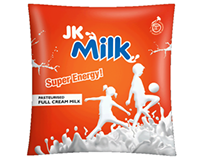
Umang Dairies, is a dairy product company of JK Organisation, which has medium-sized businesses in cement, tyre and paper with a turn over exceding $1.5 Billion. Umang’s key brands are White Magik, Dairy Top and Umang Ghee. In January 2014, it launched its liquid milk in Lucknow under the brand name JK Milk. Umang also makes products for private labels. It is managing a facility to process and pack liquid milk in poly-pouches for Mother Dairy.

The company has a drying plant (300,000 litres per day) and a liquid milk packaging plant (500,000 litres per day), both in Uttar Pradesh. Utilisation of the drying plant was just 55% in 2011-12; it is now up to around 75%. The liquid milk plant is operating at nearly full capacity now. Umang has 300 villages and 12,000 farmers in its milk collection network.

Demand for milk is outstripping production. However, demand does not easily translate into sales and profits. To quote from the Umang’s annual report, “Pressure on land resources is increasing. There is no way to increase the availability of land for fodder production. (The) Answer lies in the usage of high-yield fodder crop techniques and simultaneously replacing low yield breed of milch animals by high yield ones.”

Image 01

Umang was in a bad financial shape until two years ago. But it turned around after restructuring and revenues went up from Rs150.22 crore in 2011-12 to over Rs216 crore in 2013-14. For the quarter ended December 2014, sales were Rs69.96 crore (Rs55.20 crore) and the net profit was Rs2.60 crore (Rs1.26 crore). For the year ended March 2014, sales were Rs216.38 crore (Rs173.80 crore) and net profit was Rs5.96 crore (Rs12.30 crore).  The net profit for this quarter came at Rs 3.57cr, exactly same as last year. There is a drop in sales this qaurter but this due to the upgradation process which will increase produciton by 25%. Howevever the company managed to bring down raw material costs by 28% and this resulted in overall costs coming down by 23%. Consequently, EBITDA came in at Rs. 7cr, up 17%.

Over the past five quarters, the average growth in sales of Umang has been 44% and the average growth in operating profit was 119%.  The return on net worth is 28%.The return on capital employed is 27% with a debt-equity ratio of 0.72. The cash earnings per share were Rs3.39. Valuation is low. The 3 year average return on equity stands at 390%.Umang’s market-capitalisation is 0.5 times sales.


The face value of the share is Rs5. Umang has distributed dividends of 20% in September 2014 for FY13-14 and 15% in July 2013 for FY12-13.  The share is trading at around Rs56, at a PE of 14 with industry PE at 40.   This company  would also be an excellent takeover candidate, in case the Singhanias (the promoters) decide to exit. One recent development is Groupe Lactalis SA (Lactalis) (which is the worlds largest dairy player) has shown serious interest to buy Umang diaries.  Bengal & Assam Co Ltd  has all the subsidiary companies as unlisted . If the company decides to delist Umang Dairies Ltd , then we may get 50 -150 % return in no time but that will be quite less to long term prospect of this company.

There are only a few companies which get turnaround after BIFR scheme implementation one of them is Symphony Ltd.  There are few differences in Umnag dairy and Symphony like the business model of Symphony is superior, attractive return on capital employed and it has all India presence etc. But there are many similarities between them . No doubt, there is enough competition in the dairy sector. Good promoter backing and comfortable debt to equity may help the company grow big. Umang Dairies Ltd  may achieve similar heights and it is on the same path of Symphony Ltd. The stock is worth buying for the long term.

Defensive series: Stocks to Buy in a bear run ( Continued )

0 comments

Marksans Pharma

Marksans Pharma, which was a wholly-owned subsidiary of Glenmark Pharmaceuticals, manufacturers generic pharmaceutical products, such as soft gelatine capsules & tablets across regulated markets, in niche segments. It supplies its products to 25+ countries globally; UK, followed by US, are its largest markets. Its export business contributes to more than 99% of revenues with a focus on regulated markets.
Marksans’s manufacturing facilities are based in Goa and Southport (UK). These are audited by some of the most demanding global regulatory agencies in the US, UK and Australia. The business is driven through three subsidiaries—Nova Pharmaceuticals (Australia), Bell’s & Sons (UK) and Relonchem Ltd (UK).


Abbreviated new drug application (ANDA) approvals, led to a ramp-up in the US business in the past two years. Softgel product ibuprofen (OTC) is now selling at leading stores like Walmart, Walgreens and CVS. Other non-softgel ANDAs have also been approved and are being marketed via partners in the US. The softgel capsules market offers an edge to Marksans due to the complexity of developing the softgel formulation and high operational costs in running a manufacturing facility. 
It has generated a strong revenue growth in the past three quarters ended December 2014, averaging 34%. Operating profits grew 44% over this period, with an operating profit margin of around 30%. It enjoys a RoCE of 41% while market valuation is an expensive 22 times operating profits.


JB Chemicals & Pharmaceuticals

JB Chemicals & Pharmaceuticals manufactures and markets pharmaceuticals formulations, herbal remedies, and APIs in India. Its three brands, viz., Rantac (anti-peptic ulcerant), Nicardia (calcium channel blocker) and Metrogyl (amoebicides), feature the top 300 brands in terms of value and unit sales, as per data from IMS MAT March 2014. It is ranked 36th in the industry, with these three brands.
 
 
Its total exports income amounted to Rs574 crore which represents 58% of total operating revenue for FY13-14. The API business continued its upward momentum and, with sales of Rs99.33 crore, registered a growth of 59% over the same period, thanks to its wide presence in the international market. Its manufacturing facilities have approvals from authorities US, UK, Australia, South Africa, Ukraine, etc. JB Chemicals aims to create an additional capacity for tablets, liquids, ointments, vials, eye-drops, lozenges and diclofenac API plant by investing Rs140 crore on expansion. Clearly, there is no slowdown in its business. Over the past three quarters ended December 2014, the company has averaged a revenue growth of 11% and an operating profit margin of about 18%. This is one of the few companies on our list which makes a low RoCE of 11%. The stock is appropriately valued—lower than others. Its market-cap/operating profit is around 12. 

Century Plyboards

Century Plyboards is the largest producer of laminates in India and accounts for 7.5% share of the national plywood market. Year-on-year volume growth in plywood production was nearly 10%; it was about 19% in laminates, for the quarter ended December 2014. Almost 23% of the company’s revenue is from exports. Century Plyboards is looking to diversify into modular furniture and kitchen furnishings. It has six strategic manufacturing facilities across India to meet the steady growth in real estate and construction which will drive its growth for years to come.
All ply-board manufacturers face issues with raw materials from time to time, thanks to stricter conservation policies. Myanmar banned export of timber in August 2014 to save its disappearing forests. But Century Plyboards was not affected by the ban because it had set up a semi-processed peeling facility in Myanmar in 2013. So, while rivals, such as Greenply Industries, were hit by skyrocketing timber prices, Century Plyboards could easily export timber from its Myanmar facility. Revenues have grown at a steady rate of around 20%-25% each quarter and it was able to maintain an operating profit margin of 10%-15% over the past seven quarters. Century’s RoCE is 26% and the stock is quoted at 18 times its operating profit.

TVS Srichakra

TVS Srichakra is a well-known maker of tyres for two-wheelers, three-wheelers and off-road vehicles. It plans to launch radial tyres for two-wheelers in a couple of months. Its domestic clients include Atul Auto, Bajaj Auto, Hero MotoCorp, Honda Motors Cycles, Scooters India and TVS Motor Company. It exports its products to the Australia, Europe, Africa, South America and United States. It recently entered into 15 new export markets and now exports to over 80 countries. Exports constitute about 13% of its turnover.
TVS Srichakra enjoys the highest market share amongst two-wheeler manufacturers in India. It is projecting a 15% expansion this fiscal and similar growth next year, as it expects two-wheeler sales to rise. Over the past three quarters ended December 2014, it averaged a 17% growth in revenues. Operating profit growth averaged around 70% over this period. TVS Srichakra has maintained an operating profit margin of 9%-10%. The more positive part of the stock is its valuation. While it enjoys a RoCE of 30%, its market-cap to operating profit is around 8. 
The stocks discussed in this Cover Story will be less vulnerable to a market decline because these companies are on a track of higher growth. The growth comes from a business model that combines domestic and export revenues, or substantial export revenues. Unless there is a synchronised global downturn, as happened in 2008, these companies are expected to do well.

Thursday, 28 May 2015

Defensive Series: Stocks to buy in Declining Market

Thursday, 28 May 2015 0 comments
(Please note: This is NOT Guess the Multibagger 2, GTM-2 will be released on the weekend )

This is a new series im starting ; Safe stocks to buy even on a declining market.

The biggest hurdle to finding a winning stock-picking strategy is that no strategy works under all circumstances. Indeed, after the bull run in the Indian stock market over the past year, finding hidden gems is an even more difficult task. Companies with strong and unimpeded growth are too expensive. Companies that are not exactly of the highest quality are expensive too, thanks to the bull market that has pushed up all kinds of stocks to multi-year highs.

In such a situation, the better bets are companies that, at least, have rising earnings, that is, companies that consistently make more money than they did the year before, thanks to a good business model. There is no easy formula for picking such companies. Every method of picking stocks requires some interpretation and judgement. We need to look for companies that have a diversified portfolio of products or niche products and a well diversified geographical presence. This ensures that demand is not affected by a slowdown or restriction by government regulations in a specific country.

I have looked for stocks that meet these criteria and have found them across sectors like consumer products, building materials, pharmaceuticals, industrial intermediaries and auto-component manufacturers. The companies we have picked delivered a substantial and continuous growth over the past four quarters, thanks to some edge they enjoy. Most of them have a strong export presence which helps to improve even domestic operations. Take a look at these stocks discussed below.

Granules India

Granules India is one of the few companies to offer its clients all three components of the pharmaceutical manufacturing value chain starting with active pharmaceutical ingredients (APIs), pharmaceutical formulation intermediates (PFIs) and finished dosages (FDs). Regulated markets, such as North America and Europe, account for approximately 65% of its revenues, while the rest comes from quality-conscious customers in Latin America and the rest of the world. It is among the global leaders in manufacturing paracetamol, ibuprofen, metformin, guaifenesin and methocarbamol.


According to the figures for December 2014 quarter, 42% of the company’s standalone sales came from FDs while 25% was contributed by PFI and 33% by APIs. It has a 30% market share among regulated market suppliers of paracetamol. Granules Biocause, a subsidiary, has a 16% market share of ibuprofen suppliers. Granules India delivered a robust revenue growth of 26% compounded annually and profit after tax of 63% compounded annually over the five-year period ended FY13-14. Over the past four quarters, it has averaged a revenue growth of 16% and operating profit growth of 38%, maintaining an operating profit margin between 18%-20%. Its RoCE, at 25%, is not among the top league of companies in terms of returns; so its valuation (market cap/operating profits) is lower at 8.42.


Kitex Garments

Kitex Garments is the second largest producer of children’s apparel in the world. It has been exporting from India and is now setting up operations in the US. Its dominance in the highly specialised infant-wear market comes with an edge—it is a segment where competitors have found the going tough due to stringent safety norms. Kitex derives around 80% of its garment revenues from exports, of which 90% are to the US and 10% to Europe. It has five large clients—Gerber, Toys R Us, Jockey, Mothercare and Carters—and has added two more large clients recently, viz., Children’s Place and Kohl’s.
 
The largest manufacturer of infant-wear globally is China’s Wingloo which has a capacity of 750,000 pieces per day against Kitex’s capacity of 550,000 pieces per day, according to Motilal Oswal Research. Kitex plans to be the No.1 player in infant-wear market in the next few years.
 
 
According to analysts, to improve productivity, Kitex plans to replace sewing machines older than five years with newer ones which would increase the speed from 7,000 stitches/hour to 9,000/hour and consume one-third the power of old machines. It has now introduced an Italian robotic technology which drastically reduces labour. Similarly, it has installed a bow-making automated machine requiring just one person compared with 50 people earlier. All these measures make Kitex even more efficient. The stock has had an extraordinary run ever since it started acquiring scale and larger contracts. Over the past four quarters ended March 2015, Kitex Garments averaged a growth of 16% year-on-year. Operating profit grew at an average rate of about 80% over this period. Its RoCE is around 48% and, given that factor, valuation is less expensive than many large Indian consumer products companies. Its market-cap/ operating margin is 23 times. 

Cmp 810. Short term traders can buy at 810 for a target of 950. Long term investors continue buying in sip or at declines. ( Given to members )